
Grandma at the Crossroads
A meeting with Giles’ Grandma in Ipswich
Article by Peter Wade
Most statues demand to be noticed. This one is simply stumbled upon.
At the meeting of Buttermarket Street, Princes Street, and Queen Street, Ipswich offers something more substantial, and, I think, quietly revealing of our town. You do not approach this monument so much as enter a scene. Anyone walking toward the Cornhill, or downhill toward the River Orwell, encounters a family in perpetual motion.
At the statue
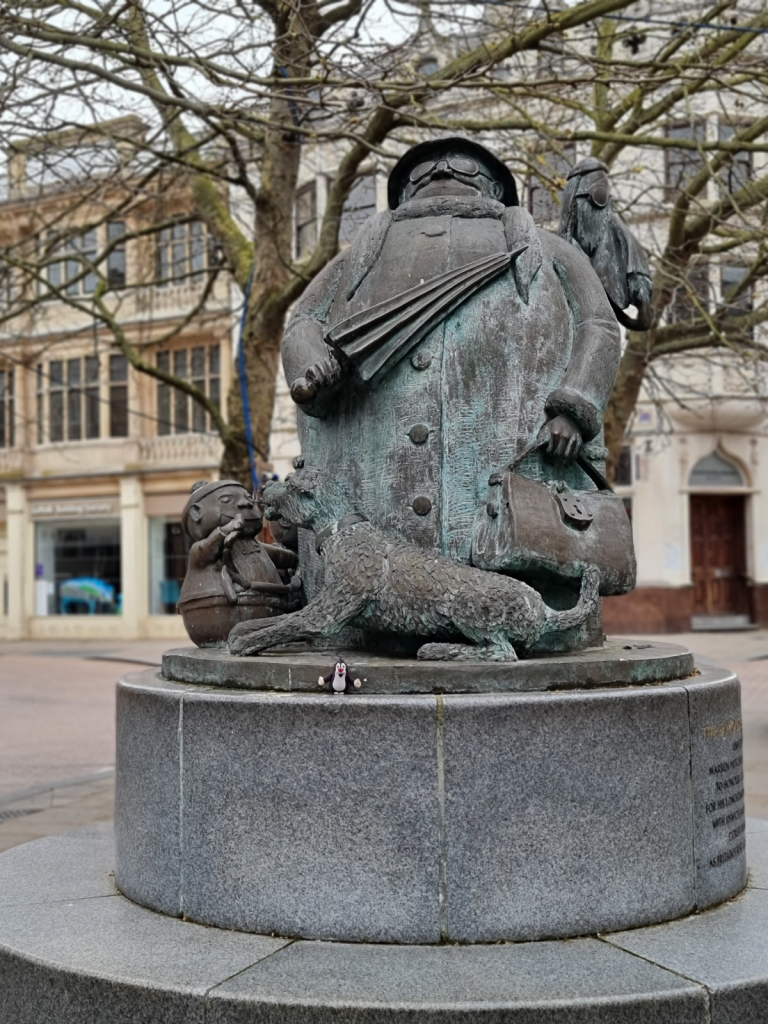
Giles’ Grandma stands at the centre, umbrella in hand, handbag firmly padlocked. Around her orbit the familiar elements of mild chaos: the mischievous twins, Lawrence and Ralph, in their matching bobble hats; the dog Rush, alert to the possibility of sausages; and Aunt Vera, pencil-thin ankles and a perpetually unreliable nose.
Giles and Ipswich
The piece, sculpted by Miles Robinson, looks upward toward the former studio of Carl Giles, as though the conversation between artist and subject never quite ended. That upward gaze matters, because Giles was not only a national figure who happened to be commemorated in Ipswich.
He belonged here in a more local and durable way than that. He came to Ipswich in the 1930s to work in animation, later made his home at Witnesham, near the town, and died in Ipswich in 1995.
Best known for his richly detailed cartoons for the Daily Express and for the anarchic world of the Giles family, he brought into British life a particular blend of satire, affection and recognition. Those cartoons, with their dense but affectionate disorder, became part of British cultural memory. Grandma, standing here at this crossing, feels less like a tribute imported into the town than something that has grown naturally out of it.
A memory carried forward
For me, though, this is not where the story begins.
As a boy in Johannesburg, I never quite carried the Giles Annual in mind from one year to the next. And so, when my father presented it to me, it arrived each time as a small treasure. I would disappear into it for days, devouring every page, returning again and again to its crowded, unruly scenes.
Those pages were full of life: children running riot, animals misbehaving, rooms collapsing into cheerful disorder. Through humour and detail, they made sense of a distant Britain, and, in their own way, helped me contend with the world’s complexities from very far away.
Years later, to come upon Grandma here, in Ipswich, was unexpectedly moving. Something from that earlier life had persisted, and was now standing in the street before me, as if it had been waiting.
The living town
What strikes me is how completely it belongs here. Giles built his cartoon world from observation, from the absurdities and tenderness of ordinary life. And Ipswich, at its best, still feels like that: multicultural, multiethnic, sometimes chaotic, usually generous. The sort of place that, as Ipswich Underground puts it, is made up of “every starving artist… every midnight poet… every hero behind a counter.”
That spirit sits comfortably around Grandma. It is there in the passing, in the small acts of attention, in the easy mixture of lives that the town carries without ceremony.
It is, perhaps, what our City of Culture bid is really reaching for. Not grandeur, but recognition. Not performance, but truth. A town that sees itself clearly, and still chooses to believe in what it is becoming.
Grandma does not stand above Ipswich. She stands within it.
And if you pause there, even briefly, you may recognise not just Giles’s world, but your own, quietly moving around you.